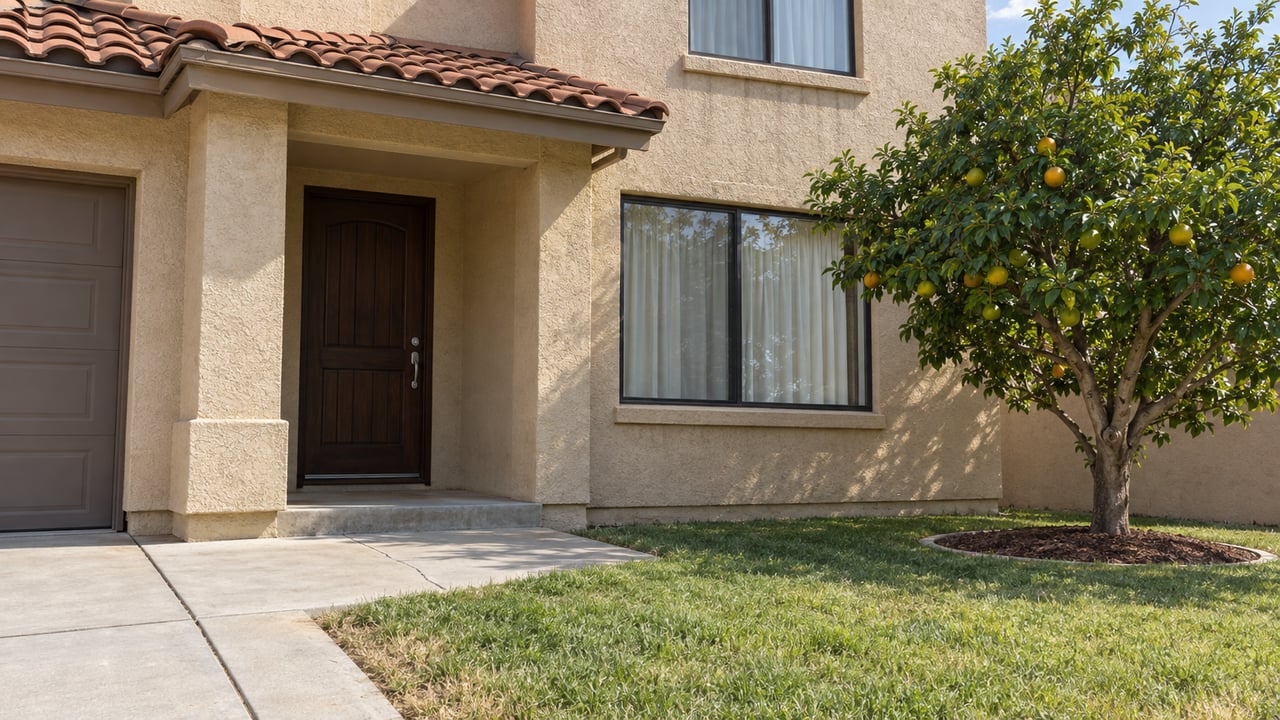
South Gate's Orchard Park Is Coming Up on Its Second Citrus Season
October 15, 2026
October 15, 2026
To reach Urban Orchard Park, you drive past industrial businesses near Firestone Boulevard until the 710 Freeway is on one side and the Los Angeles River is on the other. LAist described the trip this way: you wind through warehouses, the freeway noise never stops, and then under the new trees you can hear birds and water. South Gate's Parks and Recreation director, Steve Costley, said the same thing more bluntly in that LAist story.
"Not a natural space to think, 'Hey, let's go plant a park.'"
The park held its grand opening on July 12, 2025, and its first free community picking day came five months later. The trees, the wetland and the city's harvest programming run on a schedule that starts in winter. The months from October through spring are when the park does most of what it was planted to do.
The park covers 7 acres. Trust for Public Land, which helped design and pay for it, counts 200 fruit trees there. According to LAist, the trees are lemons, limes, kumquats and oranges, with an avocado grove and vegetable beds alongside them. The city's project inventory adds a playground with a water feature, shade structures, exercise equipment along the paths, picnic tables, drinking fountains and path lighting.
You can't see the water system, and it explains the whole park. Stormwater is diverted from the river into a 1-acre constructed wetland, which cleans it. The water is then stored in a large reservoir the city built underneath the citrus orchard. LAist reports that this stored water supplies 70% of the park's irrigation, and any overflow goes back to the river cleaner than it came out. Trust for Public Land puts the volume at 32 million gallons of polluted water cleaned in the wetlands and reused on site.
In other words, the citrus grows over the tank that waters it, and the tank refills when the river carries stormwater. Wet weather adds to the park's water supply, and the trees use that water as the fruit ripens.
The project took more than 10 years and cost more than $31 million, according to LAist. Funding came from the federal Land and Water Conservation Fund, the State Water Resources Control Board, the Rivers and Mountains Conservancy, local Measure W money, Caltrans, Proposition 68, the Conservation Corps of Long Beach and private donors. The city's own project page lists phase one at $25 million.
Nothing the city or the park's partners have published says which varieties of lemon, lime, kumquat or orange are planted. The best available guide is general harvest timing for common California varieties from the UC Master Gardeners. Those months come from a Santa Clara County program, and the same page says climate affects fruit quality and that color alone doesn't tell you a fruit is ripe.
| Fruit type | UC Master Gardener harvest window | Where mid-October 2026 falls |
|---|---|---|
| Bearss or Persian limes | August to March | Inside the window |
| Valencia oranges | April to October | Final weeks |
| Washington navel oranges | December to May | About two months out |
| Kumquats | January to April | About three months out |
| Eureka and Improved Meyer lemons | Some fruit nearly year-round, heaviest in late winter and spring | Building toward the main harvest |
Of the four fruits LAist named, limes are well inside their window right now, and Valencia oranges are at the end of theirs. Navels, kumquats and the main lemon crop all come in between December and April. In a park built around those trees, the next few months are when there's the most to see on the branches.
The park's first free community picking day was Tuesday, December 9, 2025, from 9 to 11 a.m. In LAist's announcement, visitors were asked to bring their own bags and gloves, and each family could take up to three pounds of fruit. Questions went to the South Gate Parks and Recreation Department at (323) 563-5447.
Early December lines up with the calendar above. It's the start of navel season and the run-up to the main lemon harvest. As of mid-October, the city hasn't posted a 2026 picking day, and none of the partner organizations has announced a harvest schedule. The Parks and Recreation number is the most direct way to ask.
The fruit has more than one purpose. LAist reported that the citrus, avocados and vegetable beds are meant to supply fresh produce to seniors living in the mobile home park next door, and that the city was still working out those details when the story ran in November 2025. Any public picking day shares the harvest with that program.
The city keeps scheduling events at the park while the trees ripen.
The workshops teach the same work the park needs, which is pruning, pest control and growing food with little water. The crew doing that work every day is the Conservation Corps of Long Beach. LAist reported that the Corps will maintain the park for its first three years while training young people in environmental jobs. Trust for Public Land counts 30 long-term job opportunities for young people connected to the project.
The city's park page has the basics:
The sunset closing matters more in winter. Once daylight saving time ends in November, a visit after work is short, and weekend mornings like the Saturday workshops are easier to plan around.
The city describes the park as including a mile-long extension of the Los Angeles River Trail, plus walking and bicycle paths. Its published pages don't say where a cyclist on the existing river path can enter the park, and they don't list visitor parking as a feature. If you plan to bike in or need a parking space, call Parks and Recreation before you go.
The park you can visit today is the first phase of a bigger plan. The city's project page describes a 30-acre passive park along the river, built in three phases. According to Urbanize LA's coverage of the opening, the full project will eventually take in 1.1 miles of river frontage, from Firestone Boulevard south to the Rio Hondo Channel. In 2019, Urbanize LA reported that plans for the remaining 23 acres called for landscaping, trails and a confluence outlook at the southern end. No schedule has been published for phases two and three. The city's construction page still shows the old "summer 2025" completion date, even though the first phase has been open for more than a year.
That gap is part of why the park is easy to miss. In LAist's reporting, Trust for Public Land counted parks as just 3% of South Gate's land. LAist also reported that the hope is to eventually stock native fish in the park's wetland and streams. For now, the next milestone is the citrus harvest that starts in December.
Many South Gate homeowners near Firestone and the 710 are now within a short drive of a working orchard, and they wonder whether that changes how their home compares with homes nearby. Celeste Castillo follows these neighborhood changes street by street and can show you how local features factor into your home's value. Get your instant home valuation, and if you prefer to talk it through in Spanish, hablamos español.
Stay up to date on the latest real estate trends.


Backed by years of success and experience, I’m here to deliver results that exceed your expectations. Contact Celeste today to navigate the journey of buying or selling with confidence.